As plan sponsors prepare for the changes to the limits for their retirement plans and the effects on their labor costs and talent recruitment and retention efforts next year, we offer our 2027 Internal Revenue Service (IRS) Limits Forecast.
We published the limits for 2026 in November 2025 following the announcements by the federal agencies of the annual cost-of-living adjustments, along with the corresponding limits for 2025 and 2024. In this forecast, we estimate the following IRS qualified retirement plan compensation and benefits limits:
- The maximum annual defined benefit (DB) plan annuity payable as a single life annuity. This amount may need an actuarial adjustment if the retirement date is before age 62 or after age 65, or if the participant’s elected form of payment is not a single life annuity.
- The maximum annual addition to a defined contribution (DC) plan. This is the sum of any employee pre-tax or Roth elective deferral contributions (excluding catch-up contributions), employee non-Roth after-tax contributions, employer contributions (matching, profit-sharing, or other nonelective), and any reallocated forfeitures.
- The employee’s annual DC plan limit on elective deferral contributions under a 401(k), 403(b), or 457(b) plan. SECURE 2.0 permits plan sponsors to elect to treat qualified student loan payments as elective deferrals. Recognition of such loan payments may not exceed this limit—or, if less, the employee’s Internal Revenue Code (IRC) §415(c)(3) compensation for the year—reduced by the employee’s elective deferrals for the year.
- Catch-up contributions for participants aged 50 and older. In addition to the regular catch-up contributions, SECURE 2.0 permits plans to offer higher catch-up limits for participants aged 60, 61, 62, or 63.
- The compensation limit used in the pension plan’s benefit and contribution formula(s).
- The compensation threshold for highly compensated employees (HCEs).
- The compensation threshold for key employees.
- The portion of emergency savings accounts (ESAs) attributable to participant contributions. SECURE 2.0 permits plan sponsors to add ESAs to their DC plans, allowing non-HCEs to contribute to these accounts on a Roth basis. The portion of the account attributable to participant contributions is limited by law.
- The compensation threshold triggering Roth catch-up contributions. SECURE 2.0 requires plans that offer catch-up contributions to require catch-up contributions only on a Roth basis for participants whose wages—as defined in IRC §3121[a]—exceed $145,000 (indexed for inflation) in the prior calendar year.
- The maximum eligible distribution amount from a DC plan to a domestic abuse victim is the lesser of this amount or 50% of the present value of the employee’s vested account balance, aggregating all such distributions from every DC plan of the employer (or the employer’s controlled group).
How the 2027 IRS limits will be calculated
After the close of federal fiscal year (FFY) 2026, the IRS will use the 12 months of the reported Consumer Price Index (CPI) to calculate the 2027 IRS limits. (The calculations are more complex than just multiplying the 2026 limits by the CPI, but those details are omitted here.) FFY 2026 is defined as the 12-month period from October 1, 2025, to September 30, 2026. The IRS could release its 2027 limits in October or November 2026. (The 2026 limits were announced on November 13, 2025.)
March 2026 forecast
Our limits forecast is projected using two assumption sets. One is based on the current trailing 12 months of CPI and the second assumes that year-to-date CPI (since September 30, 2025) will continue to increase each month through September 30, 2026, by an estimated 25 basis points (3.0% annual).
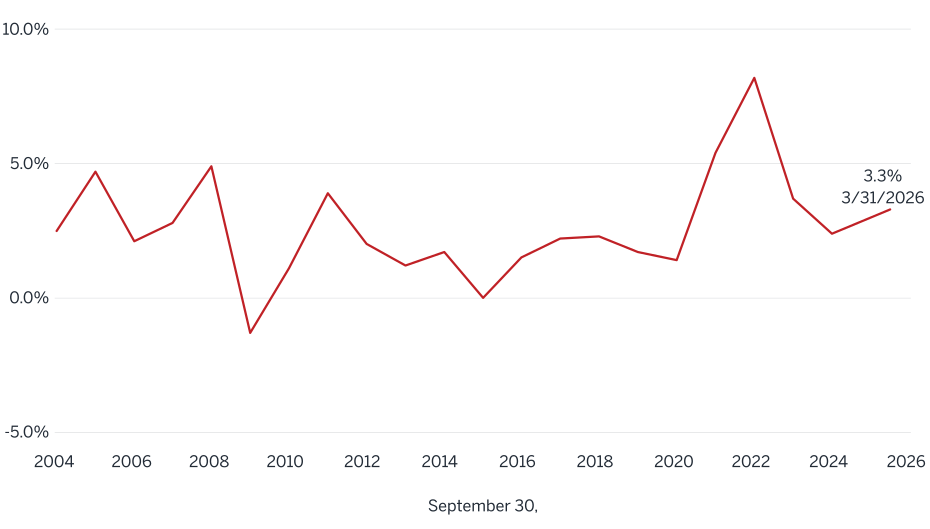
Historical rolling 12-month changes in the CPI as of each September 30 through 2025, and the current trailing 12-month change through March 31 of the current FFY, are shown in Figure 1.
Figure 1: Historical 12-month percentage change each September 30 and current trailing 12-month percentage change through March 31, Consumer Price Index, all items, not seasonally adjusted
Source: U.S. Bureau of Labor Statistics.
The CPI as reported by the BLS for the 12 months ended March 31, 2026, was 3.3%, higher than the 3.0% annual change in the CPI as of September 30, 2025 (i.e., the close of the prior FFY). It is also higher than the 3.2% average annual change over the past 10 years ended September 30, 2025, and higher than the 2.5% average annual change over the past 20 years ended September 30, 2025.
Since September 30, 2025, the CPI has increased by about 1.7%. Projecting monthly increases of 0.25% through September 2026 results in an annual increase of about 3.2% for our 6-month actual/6-month forecast projection.
Figure 2 shows the projections for the IRS limits for 2027.
The BLS is expected to release the April CPI results on May 12, 2026. We will update this forecast at that time.
Please contact your Milliman consultant for details and questions about how these limits apply to your retirement plan(s).
Figure 2: 2027 IRS Limits Forecast using actual FFY 2026 Consumer Price Index (CPI) as of March 31, 2026
| Category of annual IRS limits | 2026 IRS limits | Estimated 2027 IRS limits | Dollar increases from 2026 limit | ||
|---|---|---|---|---|---|
| Actual 12-month trailing CPI as of 3/31/2026 | 6-month actual 3/31/2026, 6 months forecast to 9/30/2026 | Actual 12-month trailing CPI as of 3/31/2026 | 6-month actual 3/31/2026, 6 months forecast to 9/30/2026 | ||
| Maximum annual annuity pension for DB plans | $290,000 | $300,000 | $300,000 | $10,000 | $10,000 |
| Maximum annual addition for DC plans | $72,000 | $75,000 | $75,000 | $3,000 | $3,000 |
| Maximum §401(k), §403(b), §457 deferral for DC plans | $24,500 | $25,000 | $25,000 | $500 | $500 |
| Catch-up contribution limit for DC plans | $8,000 Ages 60 to 63: $11,250 |
$8,000 Ages 60 to 63: $11,750 |
$8,000 Ages 60 to 63: $11,750 |
$0 $500 |
$0 $500 |
| Compensation limit | $360,000 | $375,000 | $375,000 | $15,000 | $15,000 |
| HCE dollar amount | $160,000 | $170,000 | $165,000 | $10,000 | $5,000 |
| Key employee/officer compensation | $235,000 | $240,000 | $240,000 | $5,000 | $5,000 |
| Contribution limit to ESAs for DC plans | $2,600 | $2,700 | $2,700 | $100 | $100 |
| Prior year wage threshold triggering Roth catch-up contributions to DC plans | $150,000 | $155,000 | $155,000 | $5,000 | $5,000 |
| Domestic abuse withdrawal limit | $10,500 | $10,900 | $10,800 | $400 | $300 |
Source: https://www.bls.gov/cpi/ retrieved April 10, 2026.
Actual 12-month trailing Consumer Price Index (CPI) for All Urban Consumers (CPI-U) of 3.3% ending March 31, 2026.
Actual 6-month Consumer Price Index (CPI)-U ending March 31, 2026 and 0.25% per month for April through September 2026.